Earlier this year, Anthropic ran a randomized controlled trial. Engineers were split into two groups: one worked with AI assistants, one without. Skills were measured before and after. The finding was specific and uncomfortable: the group using AI assistants scored 17% lower on a comprehension quiz covering the skills most relevant to evaluating AI output.
Not a drop in productivity. Not a drop in code volume. A drop in debugging ability, code comprehension, and conceptual understanding of systems.
The irony is precise: the skills that atrophied are exactly the ones you need most if you're going to work effectively with AI agents. The more you delegate to the agent, the worse you get at knowing whether the agent did it right.
What actually atrophied
The three areas that dropped are worth naming specifically, because they're not abstract.
Debugging. The ability to trace a failure backward from a symptom to a root cause. To read an error, form a hypothesis about where it came from, test it, and narrow the search. This is a skill built through thousands of hours of manual investigation — finding the off-by-one by stepping through the loop, catching the null reference by following the data through the call stack, discovering the race condition by reasoning about thread interleaving.
When the agent writes the code and it fails, the debugging path is different. You can ask the agent to debug it, which means the loop that built the skill doesn't run. You're observing someone else's investigation rather than doing one.
Code reading. The ability to pick up an unfamiliar codebase and build a mental model of it quickly — what does this system do, where does the data go, what can fail and where. This is also learned through practice: you build the skill by reading code slowly at first, then faster as pattern recognition develops.
Agent-generated code tends to be structurally coherent and locally readable but architecturally thin. It fits the prompt more than it fits the system. Reading it doesn't build the mental models that reading human-authored systems does, because it doesn't contain the same kinds of structural decisions.
Conceptual understanding. The ability to hold a system in your head as an abstraction — to reason about it without looking at the code. To know that "if we change the caching layer, it will affect these three downstream consumers" without having to trace through the implementation to find out.
This is the most important of the three, and the most fragile. It forms slowly, through the accumulated experience of building and debugging real systems. It degrades when you stop doing the work that builds it.
Why this is a structural trap
The trap is that none of this is visible in the short term.
Your output volume stays high. Your PRs keep landing. The product keeps shipping. The skills that are degrading don't show up in the daily metrics — they show up in the incident that takes three times as long to diagnose, the architectural decision that turns out to have been wrong in a way nobody anticipated, the junior engineer's question you can no longer answer without looking it up.
The Anthropic study measured this over a period of weeks. We don't have good data yet on what the 18-month curve looks like. But the mechanism is clear: skills that aren't exercised degrade. The understanding-while-building loop — the one where you learn the system by building it — has been broken. The understanding has to come from somewhere else, and for most engineers right now, it isn't coming from anywhere.
There's a useful comparison point in the skills shift we mapped for the AI era. The skills that rose in importance — output evaluation, failure-mode reasoning, specification quality — are precisely the skills that depend on having a strong underlying mental model of how systems work. You can't evaluate whether the agent's caching strategy is correct if you don't have a solid mental model of caching. You can't identify the failure mode in the retry logic if you can't reason about concurrency.
The foundation for the new skills is the old skills. And the old skills are atrophying.
The loop that was broken
It's worth understanding why this happened structurally, not just that it happened.
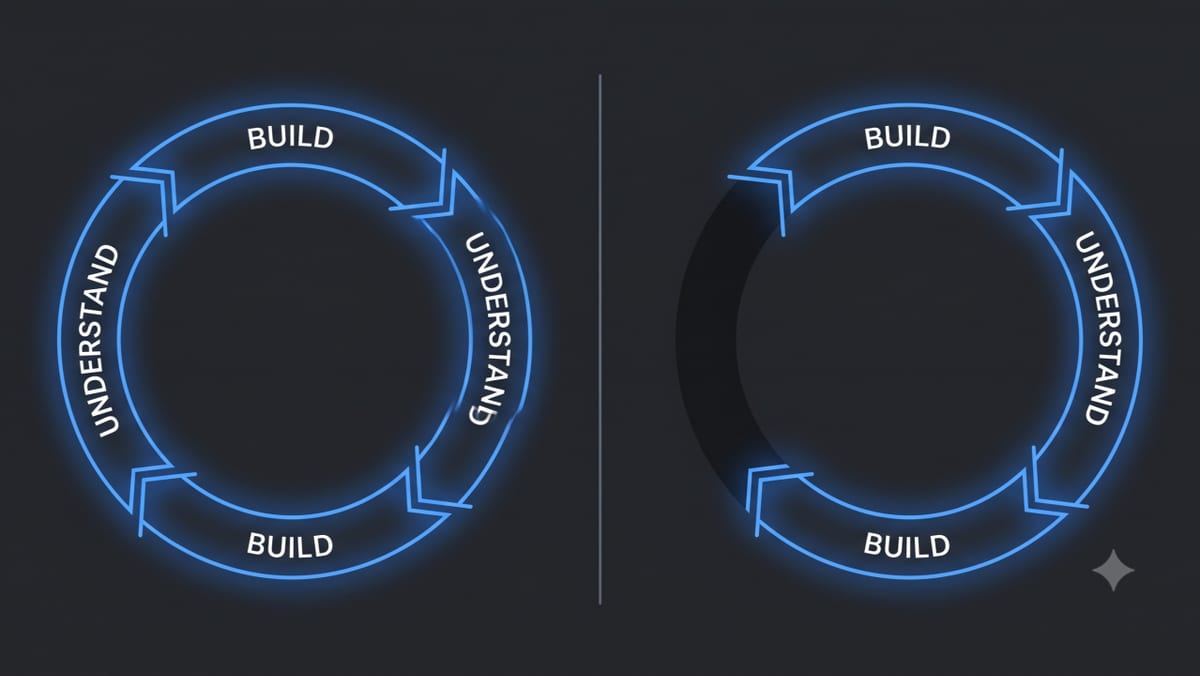
In traditional development, understanding and building were the same activity. You wrote the function and discovered the edge case in the process. You traced through the data model while implementing and found the schema didn't support what you needed. You wrote the retry loop and noticed, mid-implementation, that you hadn't defined what "failure" meant.
This wasn't inefficiency. It was how understanding formed. The act of building was the act of learning. The two were inseparable.
When an agent does the implementation, the loop breaks. The agent doesn't discover edge cases as it builds — it either anticipated them because you specified them, or it missed them because you didn't. There's no mid-implementation moment where you pause and catch something unexpected. You see the finished output, not the construction process.
The cognitive work that used to happen during building now has to happen before building. And for most engineers, it isn't happening at all — because they were never taught to do it upfront, because the implementation loop always made it unnecessary.
This is the subject of Part 4 of this series — the full mechanics of what changes when agents enter the workflow, and what you have to build to replace what you lose.
Three habits that prevent atrophy
These aren't silver bullets. They're maintenance. The same way you have to run to maintain the ability to run.
1. No-AI days, once a week minimum on something non-trivial. Pick a real task — not documentation, not boilerplate — and work through it without the agent. The goal is not to be slower; it's to keep the loop running. You're not testing your productivity. You're testing whether the mental model is still there. If you find yourself stuck in a way you wouldn't have been six months ago, that's data.
2. Interrogate before accepting. Before merging any agent-generated code, answer three questions without looking at the code: What failure mode does this have? What happens at the boundary conditions? Why did the agent structure it this way rather than the obvious alternative? If you can't answer any of them, you're in the Dumper pattern (see the previous article in this series). Answering them — even briefly — keeps the evaluation muscle active.
3. Explain it to someone. This one is simple and underrated. Before you merge, explain the key architectural decision in the PR to a colleague — out loud, without referring to the code. If you can do it, the understanding is there. If you can't, it isn't. The explanation test surfaces gaps that reading doesn't, because reading lets you follow along without fully comprehending.
None of these are radical. They're the practices that keep the skills from degrading to the point where they're no longer there when you need them.
What the interviewer is testing for
If you're interviewing at a company that has thought carefully about this, they are not testing your framework knowledge or your algorithm recall. They are testing whether the atrophy has happened.
Specifically: can you read a piece of AI-generated code and find the behavioural problem that isn't visible on the surface? Can you name the failure mode in a system you've been given a two-sentence description of? Can you specify what done looks like before you start building?
These are the exercises in the hiring side of this framework. Reading it from the engineer's perspective is useful — it shows you exactly what a careful interviewer is looking for, and the skills they're testing are the same ones the atrophy research says you're losing.
The next article in this series is precisely about that: what an interviewer who has read this framework already knows about you, before you've said a word.
© Gabor Mayer. Licensed under Creative Commons Attribution 4.0 (CC BY 4.0). Free to share and adapt with attribution.